
Our vision is to democratize the power and benefits of MCSA.
September 4, 2026
Critical motors drive pumps, fans, compressors, blowers, conveyors and many other important systems in industrial plants. While many systems are already in place to monitor and collect motor data (such as vibration, temperature, periodic inspection and reliability centered maintenance), motor current signature analysis or MCSA is particularly powerful when attempting to understand what is happening inside the motor, at its power source, and at its driven load. A key advantage of MCSA is its ability to detect developing fault conditions at a very early stage, enabling remedial action before they escalate into serious failures and result in significant costs and collateral consequences.
The motor acts as a sensor, revealing changes in load and speed through its current and voltage signatures. By analyzing these electrical signatures, we can source the problem to their electrical or mechanical source. However, we asked ourselves: “Is this all MCSA can tell us, or are we missing a bigger picture?” “What if we could see a motor’s health from all angles—not just at the moment of inspection?” “Can this data collection process be made continuous and intelligent?” These critical questions led us to develop our new application for deeper analytics.
Introducing ALERTech-IM™ 360
ALERTech-IM™ 360 builds on MCSA to provide a continuous, autonomous, and evolving 360° view of motor health. The goal is simple: to move from periodic discrete inspections to continuous understanding of motor health, with autonomous, AI-based inference and decision support.
ALERTech-IM™ 360 was unveiled online in an exclusive product preview on August 12 (see visuals below). This new application for deeper analytics is designed specifically for ALERTech-IM™ users and is being rolled out with existing clients.
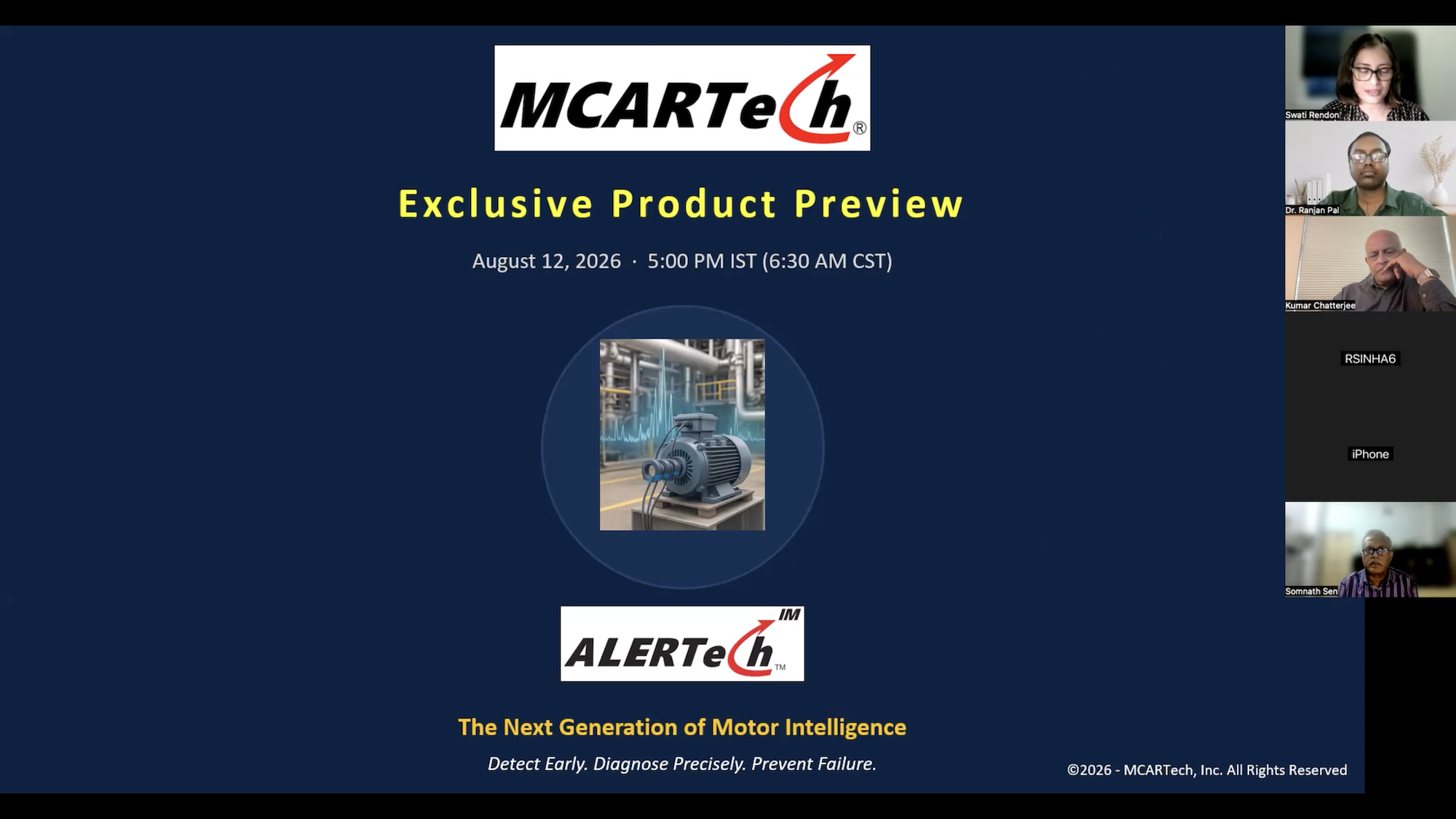
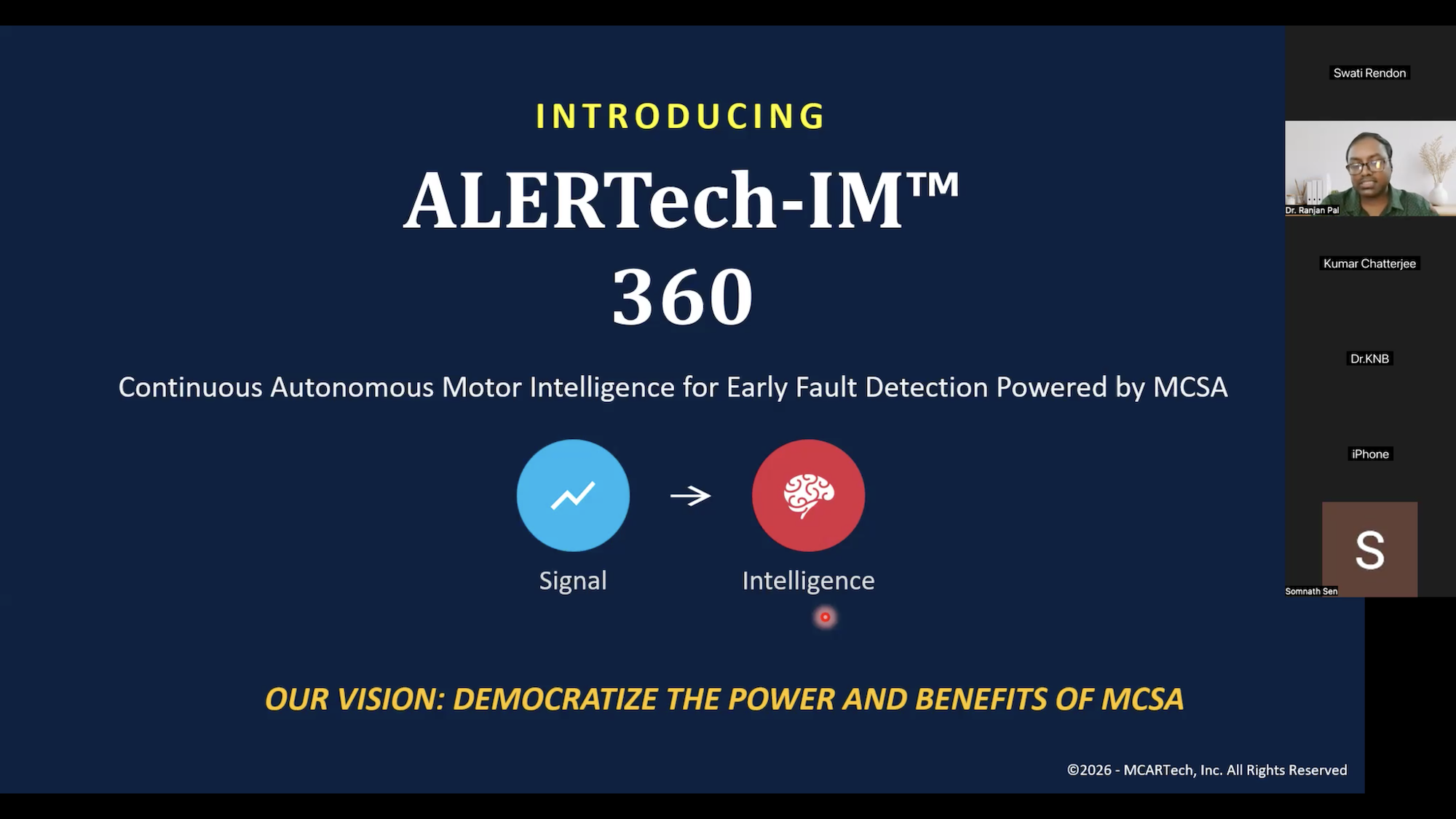
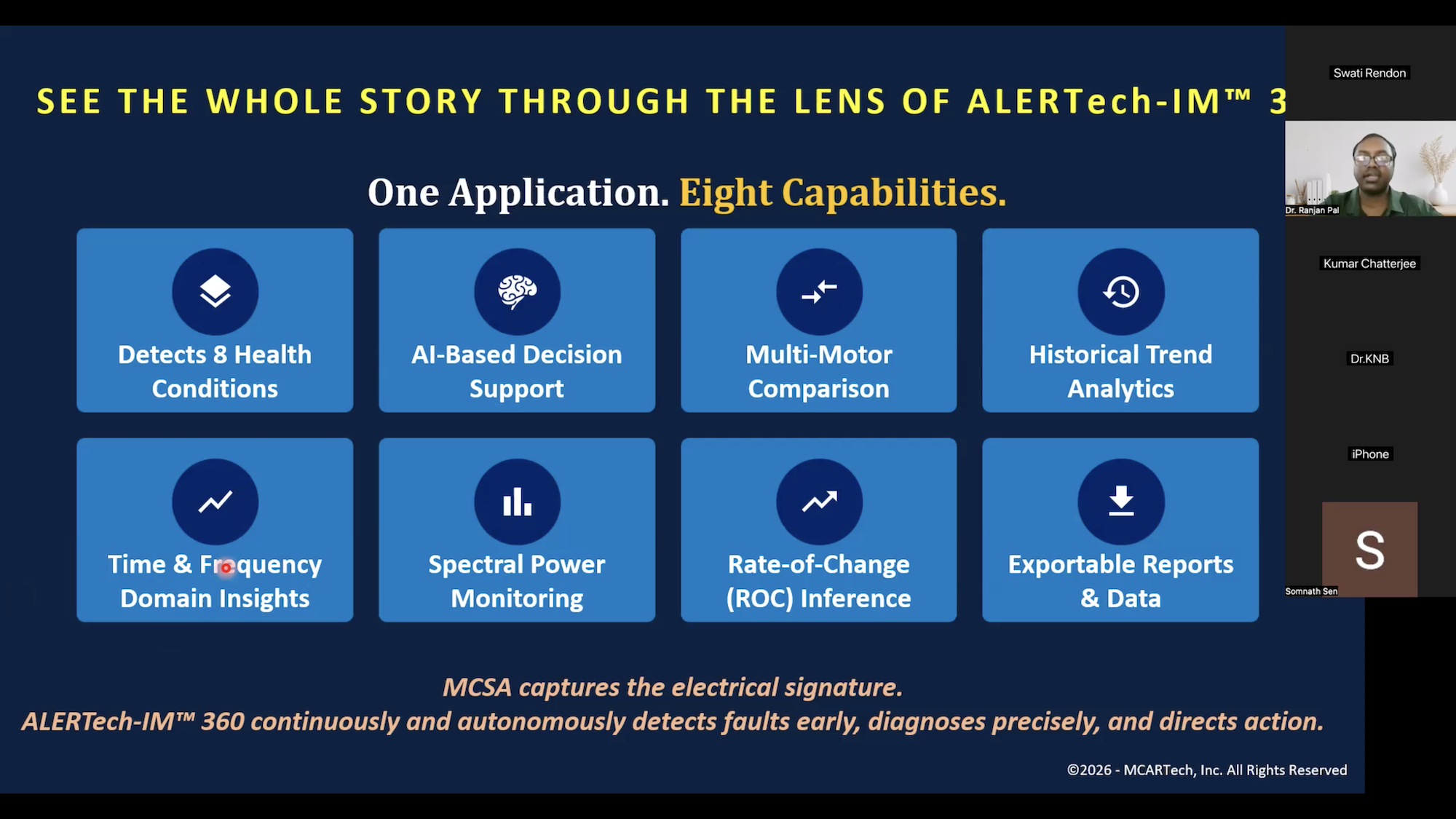
This solution will empower users to independently analyze motor data and gain an evolving picture of the induction motor and wider machine system. A single signal can now reveal multiple dimensions of motor and machine health:
Detection of eight motor health conditions: stator anomaly, total harmonic distortion (THD), rotor condition, eccentricity, bearing condition, torque overload, torque fluctuation, high-frequency anomaly. Including independent calculation of True RMS and Fundamental RMS for THD assessment, and explanation of conditions associated with elevated winding temperatures;
AI-based decision support;
Multi-motor comparison;
Historical trend analytics;
Time- and frequency-domain insights;
Spectral power monitoring;
Rate-of-change (ROC) inferences; and
Exportable reports and data.
One current signal is thus transformed into multiple health insights, while providing historical trends, comparative analysis, and AI- based decision support. This is more than monitoring motors. It is about changing how we understand, anticipate, and act on motor reliability.
To understand how ALERTech-IM™ 360 works, watch the product walkthrough by our Chief Technology Officer below.