
Motor Current Signature Analysis (MCSA) within the Smart Manufacturing Ecosystem
21 March, 2026
Smart manufacturing emphasizes systems integration, real-time data-driven intelligent analytics, and targeted decision support for asset reliability and management. Induction motors, considered amongst the most critical assets, are ubiquitous in the manufacturing and process industries, powering motion in all types of equipment.
Almost fortuitously, Motor Current Signature Analysis (MCSA) has emerged as one of the key applications within the framework of Industrial Internet of Things (IIoT). It facilitates predictive reliability by analyzing motor current data to detect early signs of degradation in induction motors.
In today’s digital environment, where continuous, real-time condition monitoring has transformed itself from an isolated diagnostics to an integrated prognostic systems, MCSA is able to translate abnormal electrical behavior into actionable insights linking field-level data to enterprise-level decision support systems.
Concept and Diagnostic Principle of MCSA
MCSA examines the stator current waveform of a running induction motor. Potential faults such as rotor asymmetry, bearing wear, air-gap eccentricity, stator winding issues, and torque anomalies disturb the electromagnetic symmetry inside the air gap. These small disturbances generate distinct frequency components within the stator current frequency spectrum.
By using signal processing tools, viz., the Fast Fourier Transforms (FFT) or the Time-Frequency Analysis, the frequency components are identified and analyzed. The frequency side-bands are correlated with mathematically derived fault frequencies that corresponds to the particular fault condition, allowing early fault identification—often well before the appearance of any performance degradation.
MCSA employs a non-intrusive method involving minimum disruptions to operations. It utilizes current transformers (CTs) for current sensing already installed for metering purposes. In practice, this makes MCSA compatible with the idea of modern industrial reliability ecosystems that support safety, efficiency, maintainability, and scalability without any significant hardware modifications or capital expenditure.
In essence, MCSA forms a diagnostic bridge between electrical measurements and mechanical health, a role increasingly important in smart manufacturing environments driven by IIoT-based monitoring and predictive analytics.

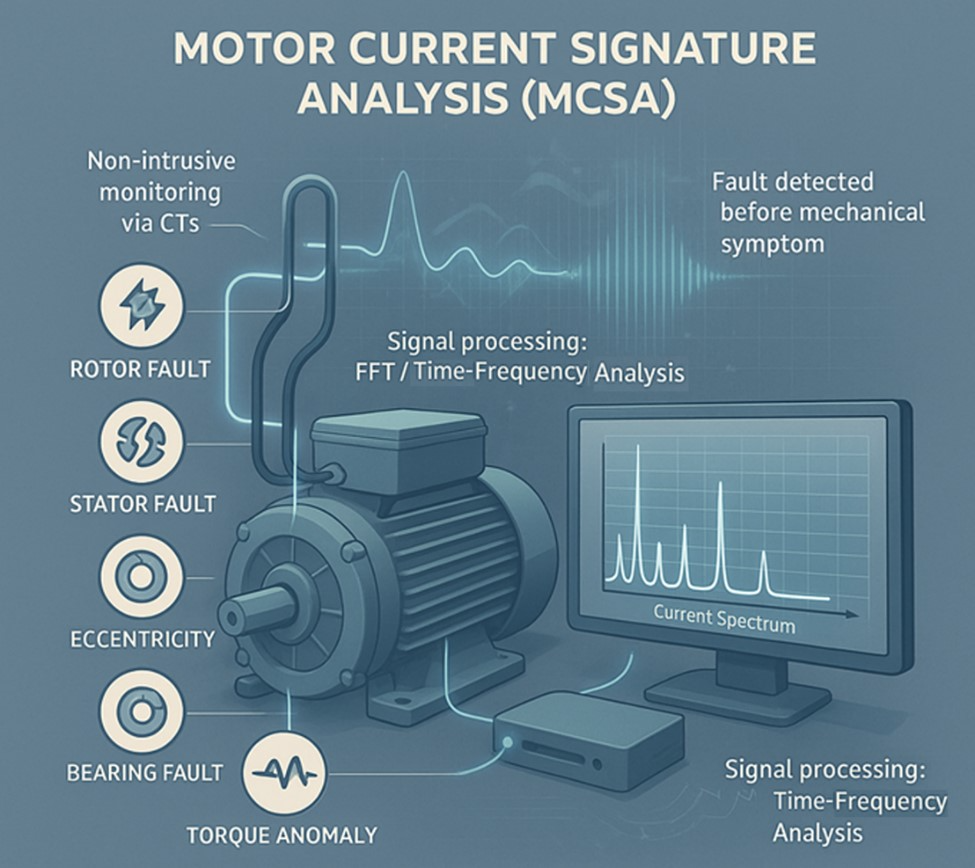

Visual credit: Prompt-refinement by ChatGPT and image generation by Google Gemini
MCSA and Reliability in the IIoT Framework
MCSA can be viewed as one element within a wider IIoT based reliability infrastructure. Typically, motor current data (sinusoidal time domain signals) from several drives are streamed to an edge device(hosting the MCSA application), processed locally, and the output data is transported to a cloud database. Such an integration lends conformity with the doctrines of Industry 4.0, viz., interoperability, information transparency, decision support, and decentralized decision making.
The overall computational flow generally follows four main steps — current capture, feature extraction, fault classification, dashboard reporting, and user notifications. This layered path tends to keep data transparent and traceable across the system.
Plant operators benefit from prompt notifications, real-time visualization, and historical data analytics, enabling recognition of a problem at its incipient stage and appropriate counter-measures. Reliability engineers can observe changes, assess fault severity levels, and then make maintenance decisions based on the detected conditions rather than just relying on routine tasks.
MCSA Integration with Smart Manufacturing and Analytics
When integrated with the plant’s Computerized Maintenance Management Systems (CMMS), MCSA becomes a part of a digital reliability twin. In an integrated environment, MCSA detections can support predictive maintenance decisions leading to improved performance indicators such as uptime, mean time between failures, energy efficiency, and effective spare parts management, to name a few.
Machine-learning models, when trained on motor current spectral features, can classify complex faults and even project Estimated Time to Failure. Cloud-enabled data aggregation further allows benchmarking of similar assets across sites. Hence, MCSA contributes directly to the cyber-physical intelligence layer of smart manufacturing.
Future Outlook
The complete application comprising of MCSA based real-time diagnostics, visualization and timely notifications is redefining how plants can ensure the reliability of their critical induction motors and prevent or mitigate the effect of catastrophic situations. MCSA, once considered as a discrete electrical test, is transforming into an integral part of a maintenance ecosystem. It supports both operational reliability and sustainability goals of the modern industry by improving human, machinery and environmental safety standards, minimization of equipment downtime, maintenance waste, energy loss, and above all, cost.
Motor Current Signature Analysis represents more than a diagnostic tool. It is a contributor to the smart, reliable, and connected factory. Through its integration with IIoT and automated alert systems, MCSA provides industries with a self-learning, scalable, and sustainable pathway toward predictive reliability in the era of smart manufacturing.